

Author: Pratik Ghadge
Buying an off-road SUV used to be a little simpler. Pick the rugged trim, add decent tires, and head for the dirt. The new 4Runner lineup does not make things quite that easy. In a good way, mostly. The big question now is which flagship trim actually makes more sense for the way someone drives.
That brings things straight to Toyota 4Runner TRD Pro vs Trailhunter. On paper, these two look almost suspiciously close. Both 2026 trims come standard with Toyota's i-FORCE MAX hybrid setup, both make up to 326 horsepower and 465 lb-ft of torque, both have standard 4WD, and both sit near the top of the 4Runner range. Toyota also gives both trims serious trail hardware, including the Stabilizer Disconnect Mechanism, locking rear differential, and 33-inch Toyo all-terrain tires.
So where is the real difference?
It comes down to mission. The Trailhunter is built more like a factory overlanding rig, while the TRD Pro leans harder into high-speed off-road performance. Motor Trend's early 2026 testing put it pretty bluntly: the Trailhunter is aimed at rough-and-tumble overlanding at a relaxed pace, while the TRD Pro is the faster desert-runner of the pair.
That is the whole comparison, really. Same family. Very different personalities.
Toyota made this confusing on purpose, and honestly, that is part of the fun.
The brand did not create one "best" off-road trim and call it a day. It built two top-tier versions with different priorities. That is why this 4Runner trims comparison matters. A buyer who mostly wants weekend trails, desert runs, and more playful suspension behavior may land in one place. A buyer who wants built-in expedition gear and more showroom-to-campsite readiness may land in another.
The shared basics are strong. Toyota says the TRD Pro and Trailhunter both get the i-FORCE MAX 2.4-liter turbo hybrid powertrain as standard, and all i-FORCE MAX 4Runner models come with standard 4WD. The 2026 4Runner line also offers up to 6,000 pounds of towing capacity.
That means nobody is choosing between capable and incapable here. This is a choice between two very capable trims that solve slightly different off-road problems.
Anyone hoping one trim completely outmuscles the other is going to be disappointed. Or relieved. Depends on the mood.
Toyota gives both trims the same hybrid powertrain, rated at up to 326 horsepower and 465 lb-ft of torque. Both also use the same 8-speed automatic transmission and standard 4WD layout. Toyota says every i-FORCE MAX 4Runner also gets a standard 2400W AC power supply in the cabin and cargo area, which is actually useful for camping and worksite life.
That means a TRD Pro features review cannot really claim a clear engine advantage. The Trailhunter is not some softer, less serious version. It gets the same muscle. Motor Trend also noted that in general specs, the two are nearly identical and even share the same wheels, tires, and key clearance figures.
So if someone is trying to decide based only on horsepower, torque, or drivetrain layout, they can stop there. It is a draw.
This is the real split. Toyota equips the TRD Pro with TRD-tuned FOX QS3 adjustable internal bypass shocks with rear remote reservoirs. The company says these are designed for superior high-speed off-road performance, and the QS3 setup allows manual adjustment of compression damping to better match terrain.
The Trailhunter goes in another direction. Toyota fits it with Old Man Emu 2.5-inch forged monotube shocks with remote reservoirs, and says they are calibrated for off-road control and load capacity. Toyota also markets the Trailhunter as the ultimate overlanding machine, which tells you exactly what it thinks this trim should do.
That is why Trailhunter 4Runner specs matter more than just the badge. This trim is not trying to be the fastest thing across whoops. It is trying to be the better long-haul dirt companion when the vehicle is carrying gear, rack loads, and maybe a more expedition-style setup. The TRD Pro, by contrast, feels more like the enthusiast pick for drivers who want more suspension sophistication at speed.
TRD Pro
Trailhunter
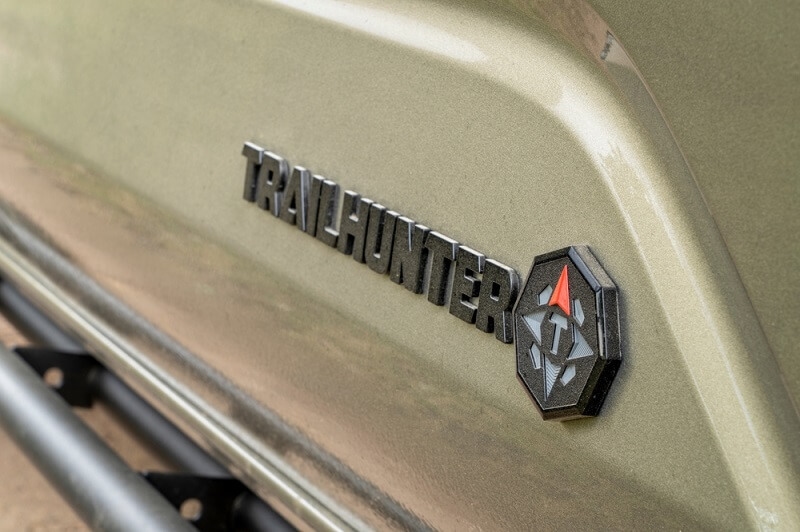
Here is where the Trailhunter starts pulling away for a very specific buyer.
Toyota loads it with a low-profile high-mount air intake, onboard air compressor, ARB roof rack, high-clearance front bumper, frame-mounted rock rails, underbody protection, and 18-inch bronze wheels wrapped in 33-inch Toyo all-terrain tires. Toyota's Trailhunter page also highlights its overlanding-specific setup and standard integrated equipment.
That changes the value equation. A buyer who knows they want roof storage, trail-air support, extra protection, and expedition-style hardware does not need to build all of that later. It is already there.
This is where best off-road SUV USA conversations get messy, because "best" depends so much on use case. For someone who wants to buy once and drive straight toward camping, long backcountry routes, and self-supported travel, the Trailhunter starts making a lot of sense. It is basically the factory answer to a build sheet many owners would eventually create anyway.
Check Out: 2026 Toyota Corolla Cross Gets Smart Upgrades for Drivers
The TRD Pro takes a slightly flashier route, and there is nothing wrong with that. Toyota gives it the FOX QS3 hardware, TRD performance air intake and exhaust, a heritage-style TOYOTA grille, and a 20-inch integrated LED light bar plus RIGID Industries LED fog lamps. The cabin also gets unique trim choices, including Black or Cockpit Red interiors with technical-camo inserts.
That makes the TRD Pro the more theatrical choice, but not in a fake way. It still has the real trail hardware. Toyota says both the TRD Pro and Trailhunter come standard with the Stabilizer Disconnect Mechanism, and both benefit from locking rear differentials and Toyota's off-road control systems.
In a Toyota 4Runner trim levels conversation, the TRD Pro is the trim that feels most like the classic halo performance model. It is the one buyers may choose because they want capability, yes, but also because they want the sharper identity and the better story when somebody asks what trim it is in a parking lot.
That stuff counts. Maybe not to everyone. Still counts.
This part is easy to miss because the suspension and accessories get all the attention.
Toyota says both trims include the Stabilizer Disconnect Mechanism as standard, which helps increase articulation at the push of a button. Both also benefit from Toyota's electronically controlled two-speed transfer case, Active Traction Control, locking rear differential, Multi-Terrain Select, Crawl Control, and Downhill Assist Control. Multi-Terrain Monitor is also available on TRD Pro and Trailhunter.
That is a serious list. It also means any honest 4Runner trims comparison has to admit that the gap is narrower than buyers may expect. This is not a case where one trim gets the real off-road system and the other gets cosmetic upgrades. Both are genuinely engineered for dirt.
So the decision becomes less about which is more capable and more about which kind of capable is the better fit.
This is where people want one clean winner. Fair enough. Real answer is more annoying.
If off-road means faster trail work, desert-style driving, and the more performance-driven suspension setup, the TRD Pro probably takes it. Toyota's own language leans that way, and Motor Trend's first test backed up the idea that the TRD Pro is the more speed-tuned machine. It was also a touch quicker in testing, though not by a huge margin.
If off-road means long-distance overlanding, gear hauling, built-in expedition hardware, and fewer aftermarket needs, the Trailhunter probably wins. Toyota clearly tuned it around off-grid travel, not just trail speed.
So the cleanest answer is this: the TRD Pro dominates performance off-road, while the Trailhunter dominates overlanding off-road. Same family. Different crown.
That is also why Trailhunter 4Runner specs and TRD Pro features review content keep leading to different winners depending on who is asking.
Choose TRD Pro If The Priority Is
Choose Trailhunter If The Priority Is
Read More: Increase Toyota 4Runner MPG With Smart Driving Tips Easy
A buyer should ask one brutally practical question before signing anything: what are they actually going to do with this truck after the first month?
If the plan includes remote camping, rooftop gear, extra accessories, and long self-supported trips, the Trailhunter saves time and build cost by arriving ready for that life. If the plan is more about driving enjoyment, faster dirt travel, sharper suspension tuning, and the emotional appeal of Toyota's most performance-focused 4Runner trim, the TRD Pro makes more sense.
And that is probably the only honest way to answer the best off-road SUV USA question here. The better trim is the one that matches the owner before the aftermarket starts taking their money.
No, neither one does. Toyota says all i-FORCE MAX models get standard 4WD, but the full-time 4WD system with a locking center differential is reserved for Limited and standard on Platinum, not TRD Pro or Trailhunter. That means buyers choosing between these two trims are still getting serious four-wheel-drive capability, just not the specific full-time setup offered elsewhere in the lineup.
Usually, yes. The Trailhunter makes a lot of sense for buyers who already know they want overlanding gear and do not want to start building immediately after purchase. With the factory roof rack, onboard air compressor, high-mount intake, rock rails, and added protection already included, it can reduce both planning time and aftermarket costs in a pretty meaningful way.
Not completely. Toyota still gives both trims modern comfort features, which helps them feel usable as daily drivers rather than weekend-only toys. Heated and ventilated SofTex front seats, current infotainment, and available JBL audio help keep them civilized on normal roads. So yes, they are serious trail-focused SUVs, but they are not stripped-down punishment boxes either.


