

Author: Shilpi Singh
If you've been following EV news lately, you've probably run into the phrase "Toyota solid-state battery" more than once. Toyota has quietly worked on this tech for over a decade, and the pitch is simple: longer range, faster charging, and a safer battery overall. Here's what's actually confirmed so far, what's still just a claim on paper, and roughly when you might see one of these on a dealer lot.
Put simply, a Toyota solid-state battery swaps out the liquid electrolyte that normal lithium-ion cells rely on for a solid one instead. Toyota's version uses a sulfide-based electrolyte, which the company says moves power more efficiently. Ditching the liquid also means less flammable material inside, which opens the door to packing more energy into a smaller, lighter cell.
Let's be honest, Toyota electric cars haven't exactly led the pack compared to Tesla or China's fast-moving EV makers. Solid-state batteries are Toyota's chance to flip that script rather than just play catch-up. If the tech pans out at scale, it could end up powering a good chunk of Toyota's future lineup, from compact SUVs to full-size sedans built on the e-TNGA platform.
Toyota clearly isn't putting all its eggs in one basket, and hybrids are still doing the heavy lifting right now. While solid-state R&D continues behind closed doors, models like the Corolla Cross Hybrid and Land Cruiser Hybrid keep selling well and paying the bills.
The latest Toyota solid state battery news suggests this has moved well past the lab-experiment phase. Back in January 2026, Toyota's partner Idemitsu Kosan broke ground on a large solid electrolyte pilot plant in Japan. That's a meaningful jump from small demo runs to something closer to actual industrial production.
Idemitsu made its final investment call and started building after two smaller demonstration facilities proved the concept worked. Japan's Ministry of Economy, Trade and Industry has already signed off on the site. Once running, expect the plant to churn out several hundred tons of solid electrolyte a year, with completion targeted for late 2027.
Toyota's prototype pack is reportedly good for around 745 miles on a single charge, which is a big number. The company is also claiming a fast charge from about 10 to 80 percent in under 10 minutes. Worth remembering, though, these numbers come from controlled lab testing, so real-world driving will likely tell a slightly different story.
On paper at least, Toyota all-solid-state EV batteries look like a genuine leap over what's on the market now. Here's a quick side-by-side of Toyota's stated targets against a fairly typical lithium-ion EV battery today.
| Metric | Toyota Solid-State Target | Typical Lithium-Ion EV |
| Driving Range | Up to 745 miles | 250-350 miles |
| Fast Charge Time | Under 10 minutes | 20-35 minutes |
| Fire Risk | Significantly lower | Moderate |
| Weight | Lighter per unit energy | Heavier |
| Mass Production | Targeted 2027-2028 | Already available |
Cost is really the wildcard here, since sulfide electrolytes and the precision manufacturing they require don't come cheap yet.
Naturally, the question everyone actually wants answered is, when will solid state batteries be in cars people can buy? Toyota's own timeline points to 2027 or 2028, though don't expect a flood of them right out of the gate. Realistically, wider availability across everyday Toyota models probably won't happen until the early 2030s.
Manufacturing solid-state batteries at scale is genuinely hard, especially keeping the electrodes in solid contact over time. Repeated charge cycles tend to crack that solid electrolyte layer, which can quietly shorten the battery's usable life. Toyota says it's cracked this problem with a flexible, crack-resistant material, though mass production will be the real test.
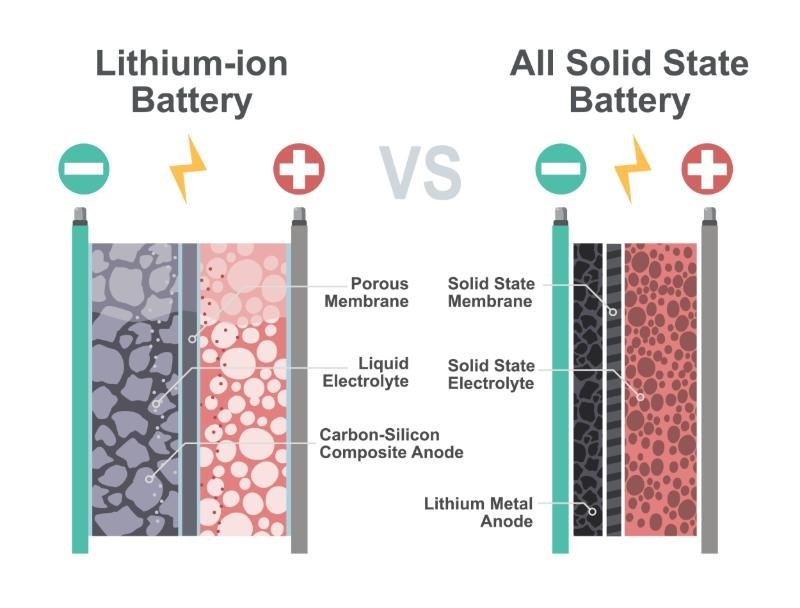
So how do solid state batteries actually stack up against the lithium-ion cells powering EVs today? Here's the short version, broken down into what matters most.
These gaps explain why automakers are watching Toyota so closely, including its parallel push into fully electric SUVs like the Toyota C-HR+ and HiAce Electric lineup.
Realistically, if you're shopping today, treat solid-state batteries as something worth waiting for rather than a reason to hold off entirely. Hybrids and current EVs are still the smart, practical pick through the rest of this decade. Once those first limited solid-state models roll out around 2027 or 2028, expect a premium price tag and pretty tight supply before things loosen up.
It swaps the liquid electrolyte for a solid sulfide one, which boosts energy density, safety, and charging speed. That design cuts fire risk while allowing meaningfully longer range than today's typical lithium-ion battery packs offer.
Toyota's aiming for a limited rollout around 2027 or 2028, starting with small production runs. Wider availability across everyday Toyota electric cars will probably take a few more years as manufacturing ramps up.
Toyota's prototype claims up to 745 miles per charge, based on internal lab testing so far. The actual range will depend on vehicle weight, driving style, and the final specs once it reaches production.
Pretty much, yes. Removing the liquid electrolyte lowers flammability risk considerably since there's no volatile liquid to leak or ignite, and solid electrolytes also handle temperature extremes noticeably better.
Almost certainly. Sulfide electrolyte manufacturing is still expensive and complex at the current scale. Early solid-state models will likely carry a premium price tag before mass production eventually brings costs back down.


